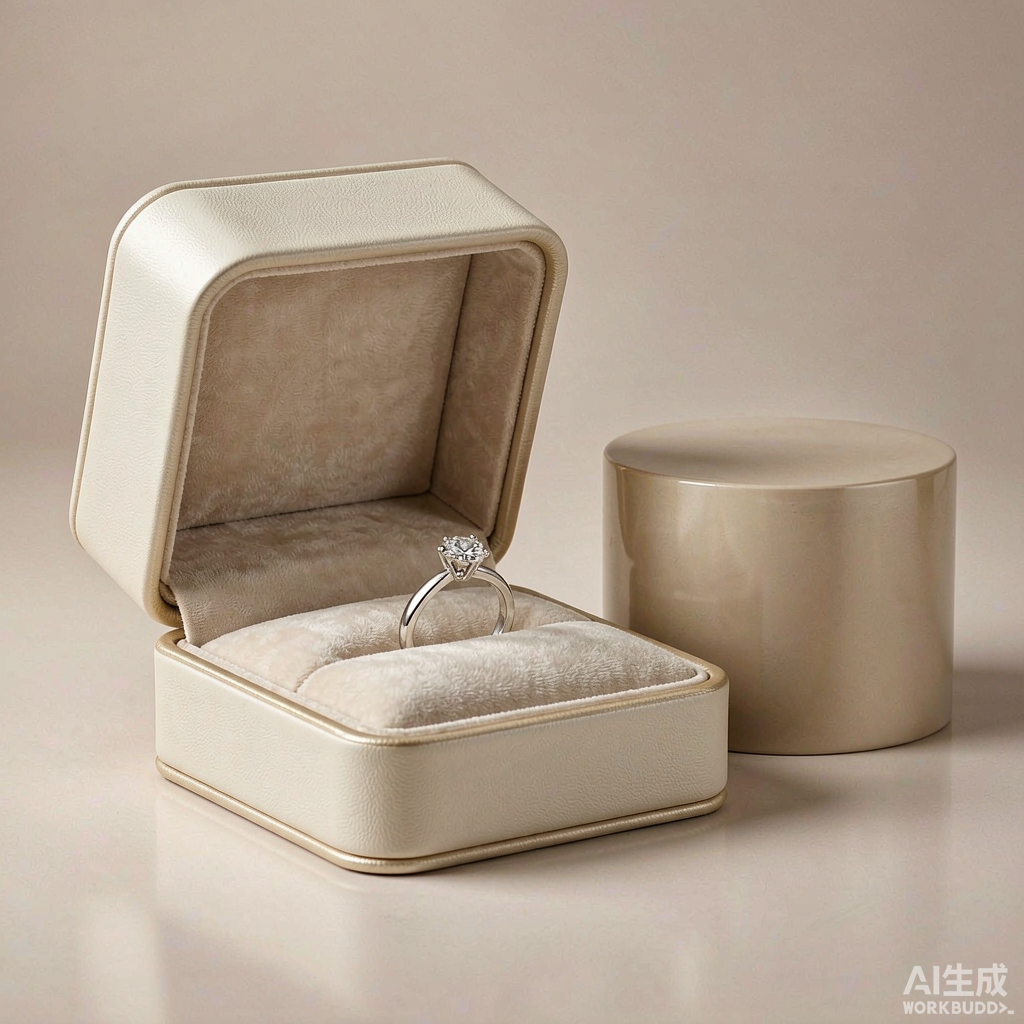
陈列道具即包装 Display as Packaging: The Prop That Ships
问:什么是"展示即包装"?柜台上的陈列道具,为什么能直接变成交付包装?
在零售行业,retail-ready packaging(货架就绪包装,SRP)早已把"运输箱"和"陈列展具"合二为一:商品出厂时就装在印刷展示盒里,到店后撕开一条易撕面板,整盒直接上架,补货从过去的十分钟压缩到三十秒左右,理货人工可省约四成。珠宝业态虽单价高、单量小,逻辑却相通——把柜台上的珠宝陈列道具做成"可封缄、可带走"的展示盒,顾客试戴满意、成交,店员合上盖就是包装。盛艺祥把这套思路叫"道具即包装":一件器物,既是被看见的舞台,也是被带走的家。英国二〇二五年试点显示,纸基 SRP 把补货时间再压缩最多四成五;对珠宝而言,它意味着顾客爱上那座展示座,本就是带走的家。
问:这么做,店主和顾客各得到什么?
店主端:少一道包装工序、少一类耗材、少一次搬运磕碰;珠宝陈列道具与交付盒统一后,库存 SKU 收敛、备货更简单。顾客端:开盒即陈列、合盖即拥有,购买动线里没有"再换一个盒子"的断裂感。据零售就绪包装研究,整合式展示使同情境销售速度提升约三成,端架 POP 陈列可带来约两成销售增长。这背后是"所见即所得"的信任——你在柜台上看见的,就是最终带走的。店员也不必再把商品从道具里取出、塞进另一个盒子,二次接触越少,货损与错配越低。
问:是不是所有珠宝都适合"道具即包装"?
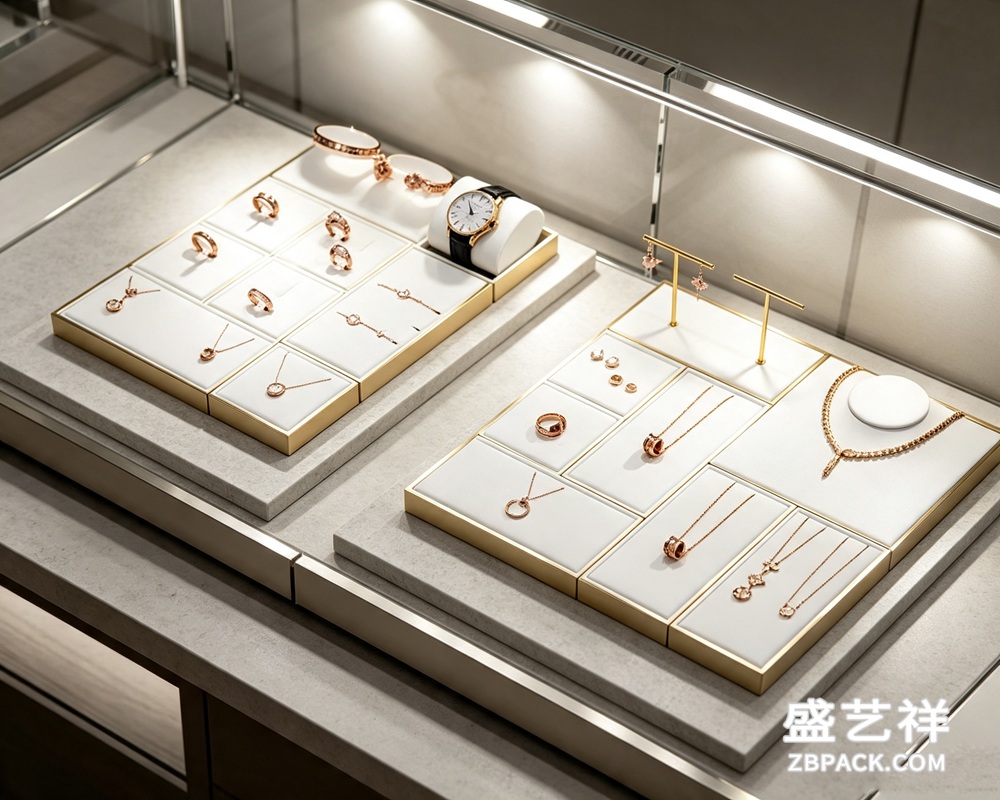
不是。最适合的是"本就该被看见"的高单价单件:对戒、主石戒指、腕表、定制吊坠——它们价值密度高,顾客愿意为"开盒那一刻"付费。盛艺祥接过的单子里,订婚对戒和腕表最常采用"展示座即交付盒":一个带阻尼磁吸的天地盖展示座,平时在珠宝摆台上是主角,成交后加一片防尘内盖、一条丝带便完成交付。相反,低价多件、易缠绕的细链与耳钉更该保留"展示道具加独立小盒"的两段式,强行合一反而增加磕碰与混装摩擦。选型口诀:单件高价合一,多件低价分装。盛艺祥曾帮一家腕表客户,把"展示绒布座加独立天地盖盒"两件套合并为单只磁吸展示盒,包装 SKU 从三降到一,旺季备货压力肉眼可见地松了。
问:结构上怎么把"展示态"稳稳切到"交付态"?
四个工程点:一、磁吸封盖代替插扣——展示时半开露货,交付时一按即锁,开合动作数控制在两步内;二、内衬不外露——展示态绒布衬里朝外吸睛,交付态加一片同色硬衬盖住,避免运输中摩擦主石;三、right-sizing 减体积——合并后整件更紧凑,按体积计费的国际快递费用显著下降,呼应全球减量趋势;四、防尘罩兼外盒——透明亚克力罩既是陈列罩也是运输外盒,去掉独立外箱一层。盛艺祥做珠宝盒定制时,会把"展示—交付"的转换写进第一版图纸,而非事后加套。亚克力罩兼外盒后,整件高度更矮,快递箱也能选更小一号,体积重再降一截。
问:这和"高端简约更受青睐"有什么关系?
高端简约珠宝首饰品包装设计,更容易被顾客青睐——在"道具即包装"上,这条规律有全新落点:少一层包装,就是少一处掉价的风险,也是少一处与环境税(EPR、PPWR)博弈的成本。当展示道具本身就是精美到能直接带走的盒子,品牌不必再用花哨外箱去"加戏",预算反而集中到指尖可感处——磁吸的阻尼、折边的零点二毫米公差、哑光触感。Macfarlane 二〇二五拆箱调研显示,过度包装的抱怨从二〇一六年的四成一降到一一成,七成消费者默认期待环保包装、逾两成会因不环保不再复购;OpinionWay 二〇二五更指出,七成六的法国人觉得到处是过度包装、近五成主动回避。可见"做减法"已不是审美偏好,而是合规与口碑的底线。简约,在这里等于"一件器物把两件事都做好"。更直接的账是:做减法的包装能把材料体积压低三到五成、包材与运费省下一成五到两成五,环保与成本本是同向。
问:怎么验收、值不值得做?
验收四项:封缄密封性(倒置不松盖)、小样跌落(合并后整件按 ISTA 3A 思路做跌落验证)、内衬公差(主石卡槽夹持力倒置不脱位)、批次色差(同一 Pantone 专色)。回报看三笔账:工序上,少一道包装、理货更快,连锁门店补货效率可提升约四成;体验上,开盒即陈列提升试戴转化与连带;可持续上,减一层即减一份材料与碳,正好踩中 PPWR、EPR 方向。盛艺祥给客户的建议是七三开:七成预算投"能被看清与摸到的转换结构"(磁吸、内衬、折边),三成留给品牌色与铭牌。一句总结:最好的包装,常常是不必再换的那一个。有客户实测,合并一层包装后单件包材成本下降约一成,连锁三十家门店一年省下的理货工时,足以再开一间体验店。
本文为原创内容,版权归盛艺祥所有。如需转载请注明出处。
盛艺祥(Shengyixiang)——高端珠宝包装设计与定制专家,为品牌护航。
Q1: What does "display-as-packaging" mean for a jewelry store?
In mainstream retail, "retail-ready packaging" (RRP/SRP) already fuses the shipper and the display: goods ship inside a printed tray, arrive at the store, a perforated panel tears away and the unit goes straight on the shelf. Restocking that once took ten minutes drops to about thirty seconds, and handling labor falls by roughly 40%. Jewelry is low-volume and high-value, but the logic transfers: build the counter prop so it can also be sealed and taken home. The piece a customer tries on becomes the piece they carry out. At Shengyixiang we call it "the prop is the package" — one object is both the stage and the home. Think of a watch resting on a branded travel stand in the window: today it is the display, and when it sells, the same stand closes into a shipping-ready case. Nothing is repacked, nothing touches a second pair of hands.
Q2: What does each side actually gain?
For the retailer: one fewer packing step, one fewer consumable, one fewer handling scuff. When the jewelry display prop and the delivery box are unified, SKUs and restocking shrink and备货 gets simpler. For the shopper: open-to-display, close-to-own — no awkward "swap into another box" moment. Integrated displays lift sales velocity by about 30% in comparable settings, and end-cap POP units can add around 20%. The trust is simple: what you see is what you keep. And because the piece never leaves the prop, staff skip the fiddly step of lifting it from a display into a separate box — fewer touches mean fewer scuffs and fewer mismatches.
Q3: Does it suit every piece?
No. It fits best the "meant-to-be-seen" singles: bridal bands, solitaire rings, watches, signature pendants — high value density, and buyers who pay for the unboxing beat. Among Shengyixiang's orders, engagement rings and watches most often use "display stand as delivery box": a damped magnetic clamshell that stars on the jewelry display stand, then gets a dust lid and ribbon at checkout. By contrast, low-price multi-pieces prone to tangling — fine chains, studs — keep the two-stage split. Forcing them together only raises scuff and friction risk. Rule of thumb: merge the single high-value item, split the multi-piece lot. A Shengyixiang client once merged a velvet watch display stand and a separate clamshell box into a single magnetic show-and-ship case; the packaging SKU count fell from three to one, and peak-season备货 got visibly easier.
Q4: How do you engineer the "display to delivery" switch?
Four points. First, a magnetic closure over clasps — half-open to show, press to lock, within two motions. Second, the lining stays hidden — velvet faces out while showing, then a same-tone rigid lid covers it for transit to avoid stone friction. Third, right-sizing cuts dimensional weight, the basis for volume-based international shipping. Fourth, the dust cover is the outer box — a clear acrylic shield doubles as the transit case, removing one outer carton. Shengyixiang writes the "show-to-ship" transformation into the first draft, not as an afterthought. When the acrylic shield doubles as the outer carton, the whole unit sits lower, so the shipping box can step down a size and the dimensional weight drops again — a quiet win on every cross-border order.
Q5: How does this connect to "high-end minimalism wins customers"?
Premium minimalist jewelry packaging design is more favored by customers — and here it gets a fresh twist. One fewer layer is one fewer chance to look cheap, and one fewer layer to reconcile with EPR and PPWR waste rules. When the display prop is already a box fine enough to take home, the brand needn't "add a scene" with a flashy carton; budget flows to what the fingers feel — magnetic damping, a 0.2mm fold tolerance, matte touch. Macfarlane's 2025 unboxing survey shows over-packaging complaints fell from 41% in 2016 to 11%, with 70% now expecting eco packaging by default and more than one in five refusing to reorder if it isn't. OpinionWay 2025 found 76% of French consumers feel bombarded by excess packaging and 49% actively avoid it. Subtraction is no longer taste — it is the compliance and reputation floor. Minimalism here means one object doing both jobs well. The arithmetic is blunter than the aesthetics: lean packaging can cut material volume by 30–50% and save 15–25% on packaging and freight. Sustainability and cost move in the same direction, not against it.
Q6: How do you check it, and is it worth it?
Four checks: seal integrity (no loose lid when inverted), drop (small-sample drop per ISTA 3A thinking), lining tolerance (the stone seat holds when inverted), and batch color (one Pantone). The payoff is three accounts. Process: fewer packs, faster restock, chain efficiency up around 40%. Experience: open-to-display lifts try-on conversion and attach rate. Sustainability: one less layer, one less material and carbon, aligned with PPWR and EPR. Shengyixiang's 70/30 rule: 70% into the visible, tactile transform structure — magnet, lining, fold — and 30% into brand color and nameplate. The best package is often the one you never have to swap. One client measured a roughly 10% drop in per-unit packaging cost after merging a layer, and the labor saved across thirty stores in a year was enough to open another experience boutique.
This is original content. Copyright belongs to Shengyixiang.
Shengyixiang — your expert in high-end jewelry packaging design & customization.